
You’ve got a novel in you
How many times have you heard someone say they’re working on a novel? Or more likely, that they have a book in them, and they just need the time. It’s a familiar story because I used to be one of those people. I even started a book once, but I didn’t get very far, and then I gave up. After all, writing is hard.
What’s next?
It was a spur-of-the-moment decision to sign up for a creative writing class after achieving an English degree post-retirement. Here again, I’d attempted a creative writing course before, decades earlier, and I flopped and dropped out. Somehow, I wanted to try again.
Encouragement
For me, the difference was an inspiring creative writing teacher. Professor Zackel gave me encouragement with my first pieces of prose, and everything mushroomed from there. I made all the mistakes that beginning authors make: clunky, unrealistic dialogue, shifting point of view, shallow characters, insufficient conflict, and lack of stakes, to name a few. Each story became a stepping stone to better writing.
Stretching oneself
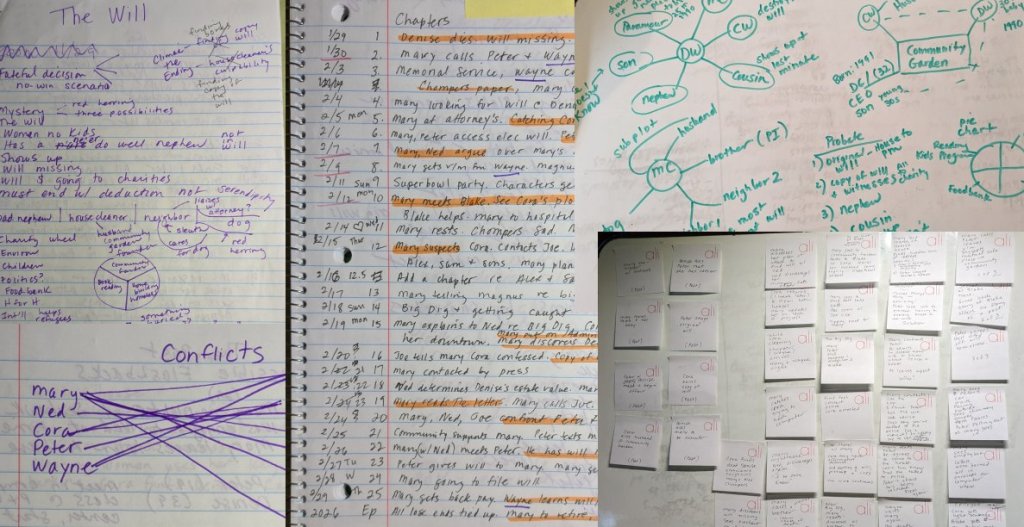
After enough short stories, a couple of which were published in the community college literary magazines, I started a more complicated work: my first mystery. It attracted me because I needed to figure out the entire story before beginning. Picture a whiteboard with dozens of sticky notes with plot points, characters, and red herrings. But before writing, I needed lots of training.
Learning
Wanting to up my game, I expanded my knowledge of how to write well. I took classes and seminars, read books, joined writing critique groups, and entered weekly prompt writing contests. Most of all, I grew a thick skin because, in order to grow, one must be receptive to criticism.
First draft
I put together a first draft, which was big on plot and small on characters and backstory. I sent it out to a couple of friends and received a little feedback. At that point, I didn’t think the story was strong enough to pursue, and I put it aside for about a year.
Second draft
A year later, I picked up the mystery story again, which at this time was called “The Will.” I thought this was okay, so I reworked it. To get more feedback, I asked a few friends and acquaintances if they’d be willing to be in a group of beta readers. To my astonishment and gratitude, I found six willing participants.
Beta reader feedback
I received excellent feedback from the beta readers! Most importantly, they pointed out some plot holes and characters that needed stronger backstories. For example, one might say, “I don’t think that character would agree to that venture so quickly.” Fair enough! I created a list of every note they gave me and categorized their criticisms into groups. Examples included: “need to fix,” “need to tweak,” and “ignore this comment because it’s my story.”
The rewrite took months and expanded the length of the story by over 20%. I changed the name to “The Garden Plot” (get it?), which I loved but learned later that name was already taken.
Next steps
At this transition, I needed to decide whether to go forward. I learned what would be necessary to publish my work and how much it would cost. (By the way, I supportive partner is paramount!) After much research, I determined I needed professional editing and book cover art, necessities for having one’s work to get noticed.
But wait, did you know that there are several types of editing? I didn’t. According to Reedsy, there are five different types. I always figured that my husband, Larry, and I could do the proofreading (more on that later), but I thought I could benefit from an editor.
Editing
I proofread my story an exhausting number of times before sending it to the editor. Based on my input to her, she determined I needed copy editing (e.g., sentence structure, word choices), but agreed to point out any developmental errors (e.g., plot holes), if she found them. She had some sixty comments, of which I accepted 99%. Mostly, I needed to add “action beats,” which are narration summaries to describe character reactions and actions during long dialogue passages. Taking to heart the editor’s comments, especially the developmental issues, I added a chapter, a few passages, and sentences to make the story the best I could.
Book Cover
Regarding the cover art, I had a pretty good image from AI, so that was another place for potential cost saving. But cozy mysteries have book covers with a particular look and feel (vector graphics). After I learned that the two most important elements for a book to sell are: hiring an editor and having a fantastic book cover, I hired a pro. I’m so pleased with the cover, and most of all, it fits in with the “competition.”
Proofreading
As I mentioned, my husband, Larry, and I always thought we would do the proofreading ourselves. But after reading the story countless times—I mean, we couldn’t stand to read it again—we happily gave it to a fresh set of eyes. Never regretted hiring a proofreader for a second.
Can self-publishing be profitable?
I can’t deny this is a vanity project, meaning it would cost, not make, money. I asked, “When can a first-time author expect to be profitable” on a seminar. The honest answer was, “not with the first book.” I loved the frankness. Fortunately, my husband backed my endeavor, and I leapt forward.
The technical stuff
I went the KDP (Kindle Direct Publishing) route on Amazon as my story was just going to be an ebook. Although Amazon gives writers free ISBN numbers, they have drawbacks, so I bought my own. There was a learning curve in ordering them and getting approved.
I didn’t trust the conversion from one format to another. The story was in Word and then got transformed into EPUB and then got uploaded to Kindle. Every paragraph, every page, needs to be checked. Spacing and indent errors occurred, which I caught.
I thought I was ready to go live, but it took a full week with Amazon to iron out the wrinkles. For example, I planned to make the ebook free and included that in my keywords, but Amazon wouldn’t let the story be free, so my keywords saying “free” conflicted with the $.99 price tag.
Your story is LIVE
After the story went live, I felt more relieved than excited. But then there’s more work to do, like creating an Author Page and claiming the book on Amazon, updating the website, and creating an author presence on Goodreads. But it is exciting too!
Getting the word out
I did a soft launch, meaning that the novella was available on Amazon as a Kindle, but I didn’t want to tell the world yet. I told carefully chosen people and wrote them each personal emails to announce the book. I hoped that I’d get a few reviews posted before telling the world.
Tweaking
Then there’s more technical stuff like categories and keywords. For now, I’m trying to figure this out on my own, but rest assured, there are products out there eager for me to pay them to do a better job than I can. The jury is still out on this one.
Old Fashioned Marketing
Writers joke that their work is finished after they finish a book. Unless one has a publishing house to create a website, monitor several social media channels, and produce content for an email marketing list, the work has just begun. And marketing takes away from writing. I created a website, and I used to be a social media manager, so I work those channels some. I refuse to have another email list, though. Being old-fashioned, I created business cards with the book cover on one side and a QR code on the back. As I go about my day and talk to people, I hand them out if my book comes up. Funny how it keeps coming up in conversation. 😉
What’s next?
I’m already working on a follow-up novella, and eventually, I hope to have a trilogy. I must be crazy after writing the above, but I hope the process will be easier the next time.
How about you?
Are you one of those who have always wanted to write a book? Have you started? Does reading the above encourage or discourage you? Maybe this will help you decide. Amy L. Bernstein wrote an article on Jane Friedman’s website about the number one requirement of having a writing career: “The Secret to a Writing Career May Boil Down to Sheer Grit.” Writing is a part-time job for me, but I agree it takes a lot of initiative and determination. Enough said, and good luck with your writing!
For a page-turning escape to Lake Waluga full of twists and surprises, head here.
 Kristy Schnabel
Leave a comment